Neues Museum
Project Details
£50M or more
Practice
David Chipperfield Architects Ltd
22 Little Portland Street , London , Greater London , W1W 8BU , United Kingdom
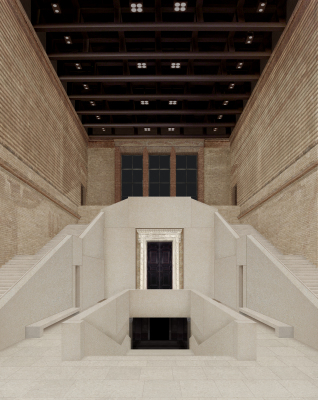
In 1997 David Chipperfield Architects won an international competition for the restoration of Friedrich August Stüler’s 1859 Neues Museum. Located on the Spree Island, in the heart of the former east Berlin, the building had initially been constructed to extend the space of the Altes Museum, built immediately to the south by Stüler’s teacher Karl Friedrich Schinkel. The original Neues design had formed part of an overall architectural concept for the Spree Island, prompted by Friedrich Wilhelm IV, of a series of art and archaeological museums styled so as to promote a greater appreciation of classical antiquity. Among these museums, and in terms of its construction and rich interior decoration, the Neues Museum was considered the most important monumental Prussian building of its era. Seen today alongside the four other reconstructed museum buildings on the island, Stüler’s Neues Museum is the only structure still ruined from the war – a contrast that demonstrates ideas of history and decay in a compelling and powerful way, although throughout the building the degree of destruction varies greatly. Certain interiors have survived almost completely, with elaborate finishes and ceiling frescos still intact, while other building elements exist only as the enclosures of a gaping void. The power of the ruin not least stems from this exposed brickwork shell, investing the building, 150 years after it was first imagined, with the indelible presence of a picturesque classical ruin. Given this evocative yet inaccessible space, the restoration of the Neues Museum followed a principle of conservation rather than reconstruction – that is, the design gives back only enough context so that the significance of the whole structure and the sequence of spaces contained within it are legible. Accordingly, the missing north-west wing and south-east bay are rebuilt, the enfilade of rooms is restored, and the stair and courtyard spaces are designed so as to maintain elements of the building’s own decay. In this way, the new Neues Museum and its collection of Egyptian antiquities should navigate carefully between de-historicised reconstruction and monumentalised preservation.