Museum of Modern Literature
Project Details
£10m to £49.99M
Practice
David Chipperfield Architects Ltd
22 Little Portland Street , London , Greater London , W1W 8BU , United Kingdom
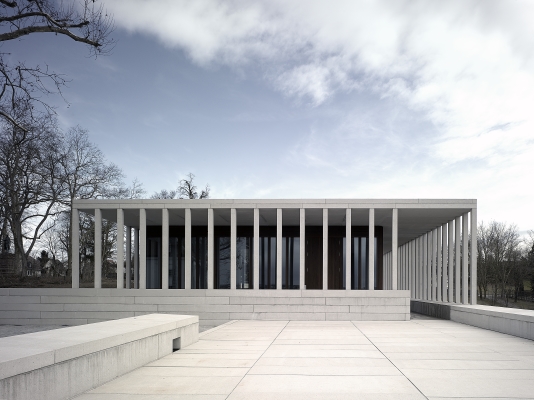
The new Literature Museum will be formally opened in June 2006 by the German Federal President. The museum is located in Marbach’s scenic park, on top of a rock plateau overlooking the picturesque valley of the Neckar River. As the birthplace of the dramatist Friedrich Schiller, the town’s park already holds the German Literature Archive, the National Schiller Museum, and a monument to the writer, immediately alongside which the new museum will stand. Displaying and archiving works of 20th century literature, notably the original manuscripts of Franz Kafka’s The Trial and Alfred Döblin’s Berlin Alexanderplatz, the museum will also provide panoramic views across and over the far distant landscape. By means of a sequence of terraces, the architectural concept for the museum proposes to connect the lower park level to the forecourt of the Schiller Museum. In this way, by utilising the steep slope of the site, the terraces allow for the creation of two very different characters – an intimate, shaded entrance on the brow of the hill, and a grander, more open series of tiered spaces facing the valley below. Entered from its highest point, the pavilion-like interiors of the museum therefore reveal themselves the more one descends down through their display and archive spaces. Inside, the exhibition floor is made up of a mixture of halls and galleries of varying proportions and alternating ceiling heights. Housing and displaying manuscripts, transcripts, and catalogues, the majority of these spaces, because of the fragility and sensitivity of the works on display, are contained in the lower part of the building, in timber-panelled rooms illuminated only by artificial light. At the same time, each of these environmentally controlled spaces borders onto a naturally lit gallery, so as to balance views inward to the composed, internalized world of texts and manuscripts with the green and scenic valley the other side of the glass.